Before you go —
we send free sample boxes to businesses evaluating our strips.
No minimum. No obligation. Just try them on real nails.
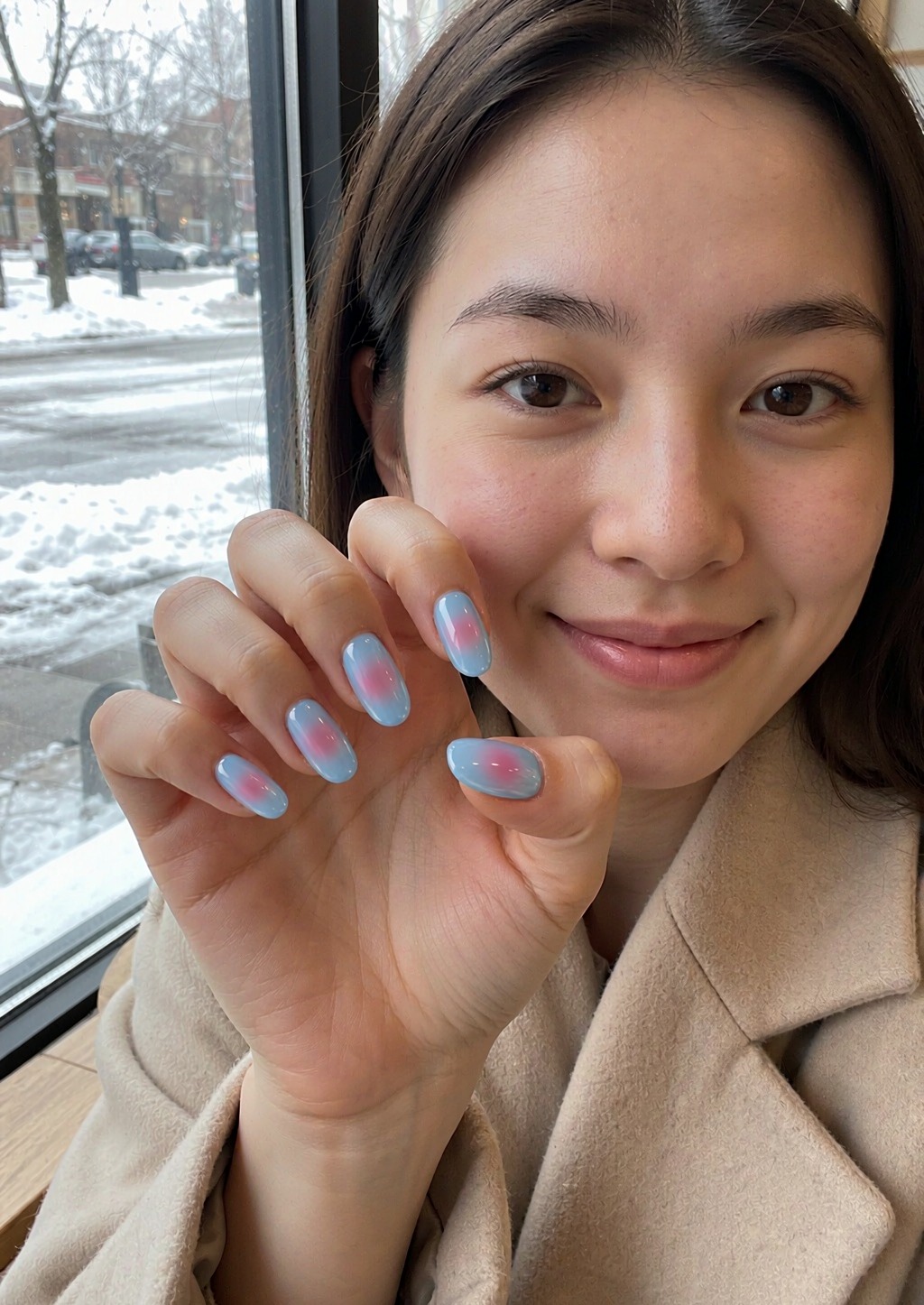
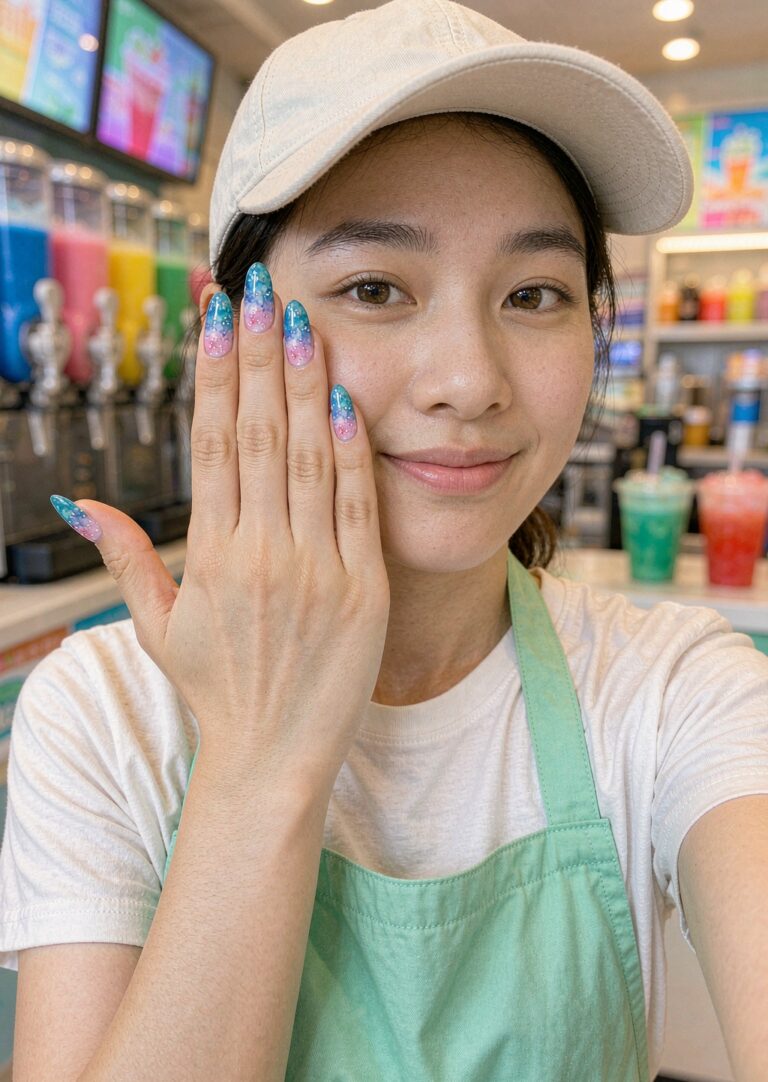
A customer unboxed her order at the kitchen window, held the sheet up to the daylight, and emailed me before she’d even applied the first box: “the blue really does melt into pink — my phone photo doesn’t do the gradient justice.” Ice blue at the edge, a soft rosy core at the center, one smooth fade across each strip. Her three friends got the photos that same afternoon — two of them opened the product page before dinner.
Most of my marketing is me explaining things: how the strips cure, why they don’t chip, what the lamp does. Useful, but it’s work. Blue Aura Thermal doesn’t need the explanation — it needs one photo. Ice blue melting into a soft rosy core at the center of each nail: a printed aura gradient that reads like a salon airbrush job. No trick to it, no angle it hides from — what you see on the sheet is what cures onto the nail.
That changes the whole sales motion. I don’t describe the design; I show it. Every listing I run leads with a close-up of the sheet and a worn shot, and the gradient does the selling — customers can see exactly what lands on their nails, no imagination required. My customers’ photos do the same job online: a manicure this crisp gets posted, and every post is a storefront. That’s the “wait, where are these from” moment, and you can’t buy it with ad copy.
Aura designs are unforgiving, and so are the buyers who order them. Across this category, the loudest complaints are adhesive failure and incomplete curing — real lines pulled from one-star reviews: “Still feel a little sticky after 45 seconds.” “Needs to be under that lamp for three cycles.” And when marketing over-promises, buyers say it straight: “No way do these nails stay on 14 days.”
A mood-ring nail with a soft, half-cured gel layer is just a smudge. The factory I source from tempers its semi-cured UV gel during formulation — same idea as tempered glass — so after 60 seconds under a UV/LED lamp the layer cures genuinely hard: scratch-resistant, impact-tough, no top coat, and it stays glossy. No “three cycles,” no multi-day avoid-water fine print baked into the routine. On this design specifically, that hardness is the difference between “stunning for a day” and “still stunning on week three” — and the wear-time claim on the box is one you can actually keep.
I wear everything I sell, so here’s the honest log on this set:
The routine is deliberately simple, because simple is what customers actually finish: no pre-trimming needed (you can shape the edge after curing), an alcohol pad if you have one — a dry tissue works too — press the strip slightly smaller than the nail from the center outward without pressing onto the skin, scissors for a rough cut, 60 seconds under the lamp, file smooth. Each box has 24 strips in mixed sizes, so one box fits a whole hand without leaving you six widths you’ll never use.
I retail these at $5.99 a box and the factory invoice says $0.89 for the 24-strip edition — about an 85% margin before fees. Minimum order is 20 boxes per design, which is roughly one profitable weekend at my volume. The catalog behind this factory runs past a thousand designs, and they do OEM and private label without a design fee, so “my own nail strip brand” is a smaller leap than it sounds. SGS, MSDS and packaging compliance documents come before you ask — if you sell on Amazon or into the EU, you know that sentence is load-bearing.
(1) The name says “Thermal,” but the look is a static aura gradient — there’s no color-change trick, and I say so up front so nobody buys it expecting one. (2) Your customers need a UV/LED lamp; I bundle one as an upsell. (3) The eye-catching designs — this is one — sell out between restocks faster than the basics.
Blue Aura Thermal is on the factory’s wholesale site with the full sheet, the mixed sizes and the wholesale price — the $0.89 is real. Order the 20-box minimum, wear a set yourself, and shoot one close-up of the sheet plus one worn photo. Those two images will outsell anything you write about it. That’s not a criticism of writing — it’s just what a product that demos itself is worth.
Wholesale and OEM enquiries: semi-cured.com — inquiry form on site.