Before you go —
we send free sample boxes to businesses evaluating our strips.
No minimum. No obligation. Just try them on real nails.
If you teach piano for a living, you already know the deal: your hands are in the frame all day, every day. They demonstrate scales, they point at measure numbers, they model a relaxed wrist for a seven-year-old, and they get mentioned in parent updates (“her hand position improved so much!”). You are, functionally, a hand model with a curriculum.
I teach about thirty lessons a week from my home studio, and I want to talk to you about the nail problem nobody warns you about at pedagogy school — and the $5.99 fix I now order like office supplies.
Run the list with me. Long natural nails? They click on the keys and teach your students bad habits by example. Polish? It chips by Wednesday, and on Thursday you’re demonstrating a two-octave scale with chipped polish while a child stares at your thumbnail like it’s a puzzle. Salon gel? Lovely, expensive, and the growth gap shows up right when recital season does.
And stickers — the cheap kind — have their own signature failure. A review I read before wasting money on a set put it perfectly: “they catch on things, like my hair.” Piano teachers know exactly where a catching edge goes: the felt of the keys, the sheet music pages, and every sweater sleeve you push up to show a student how the wrist floats.
The reason semi-cured gel strips work for keyboard life is the curing. These are real gel polish in film form, about 60% pre-cured. You press one on (slightly narrower than your nail, smoothed from the center outward, kept off the cuticle), trim the tail with scissors, and give each hand 60 seconds under a UV/LED lamp. What comes out is rock hard, edge-sealed, and smooth. Nothing protrudes. Nothing snags. The keys feel exactly the same under your fingers, which matters when you’re the person teaching other people how those keys should feel.
No top coat, no drying wait between students. If a student cancels, you can do your nails in that twenty-minute gap and be fully cured before the next one walks in. Try that with polish.
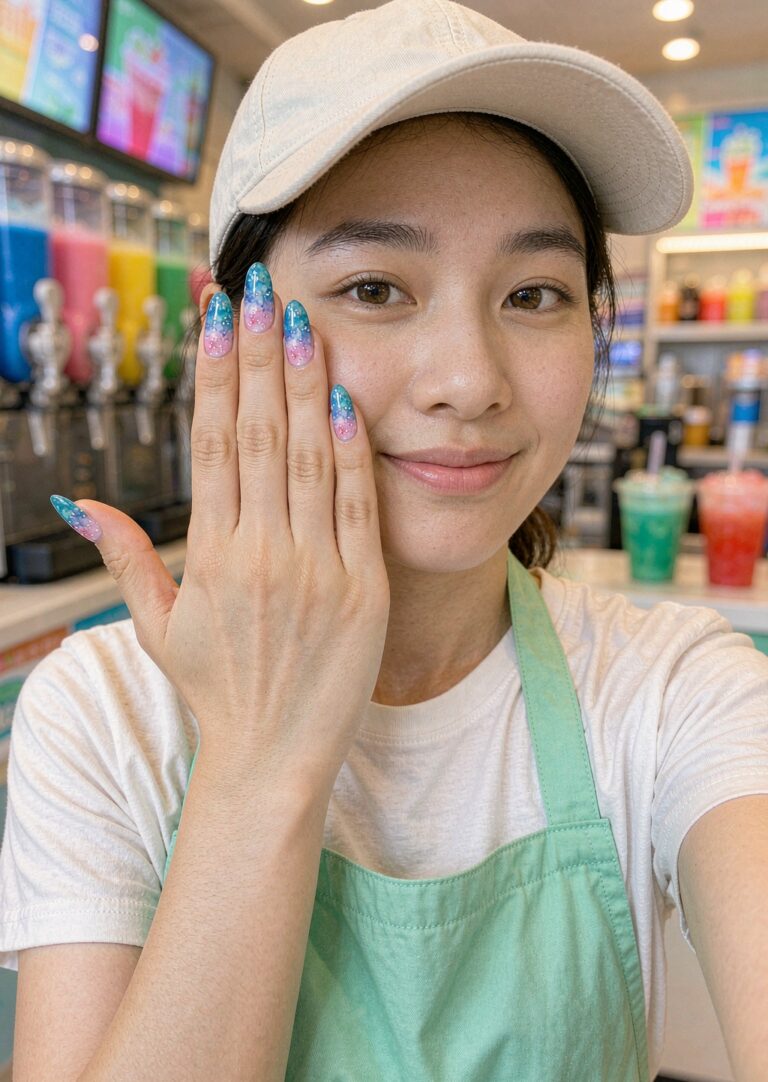
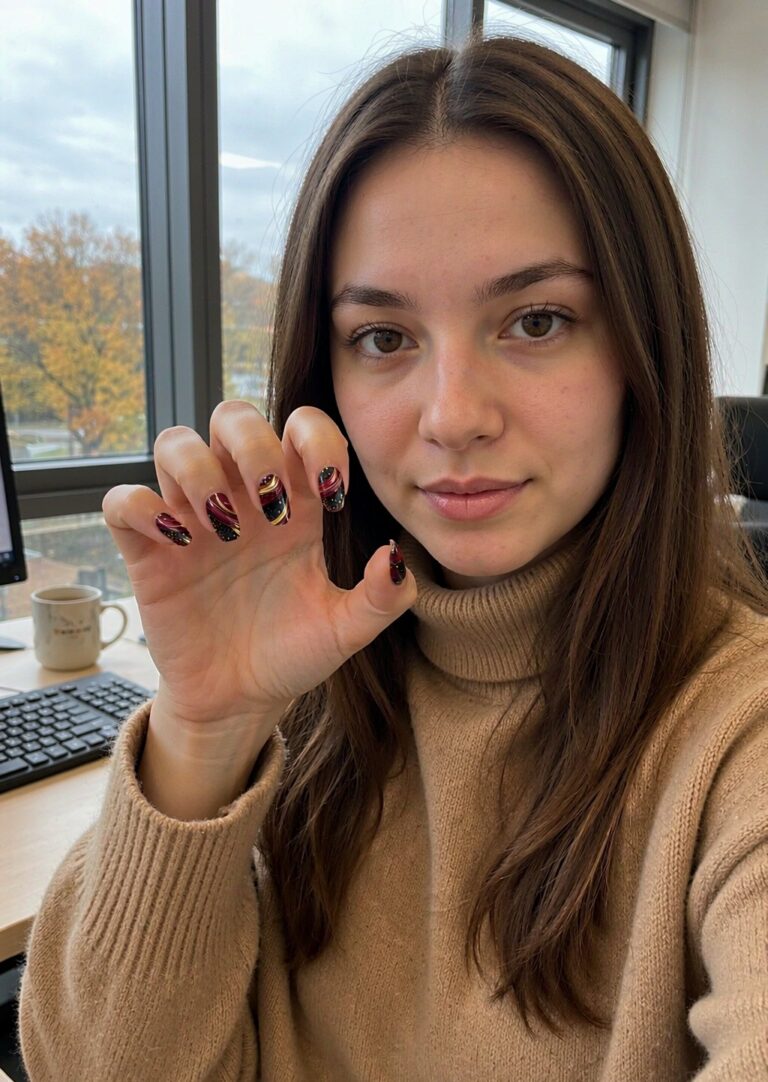
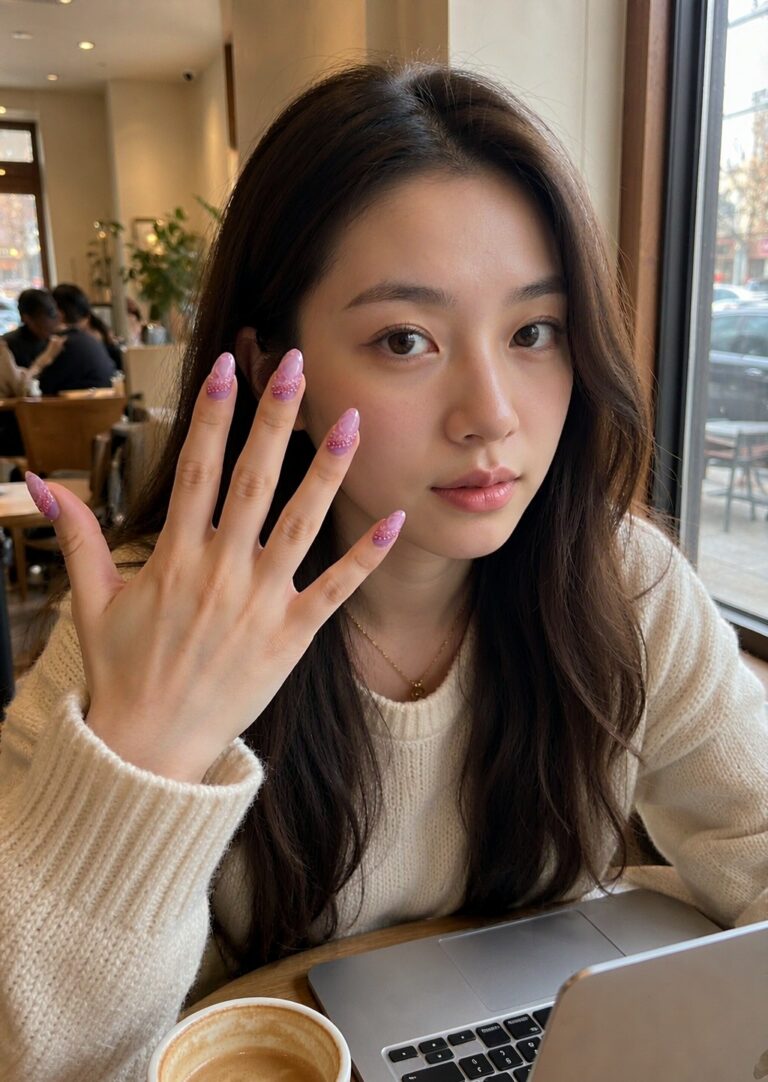
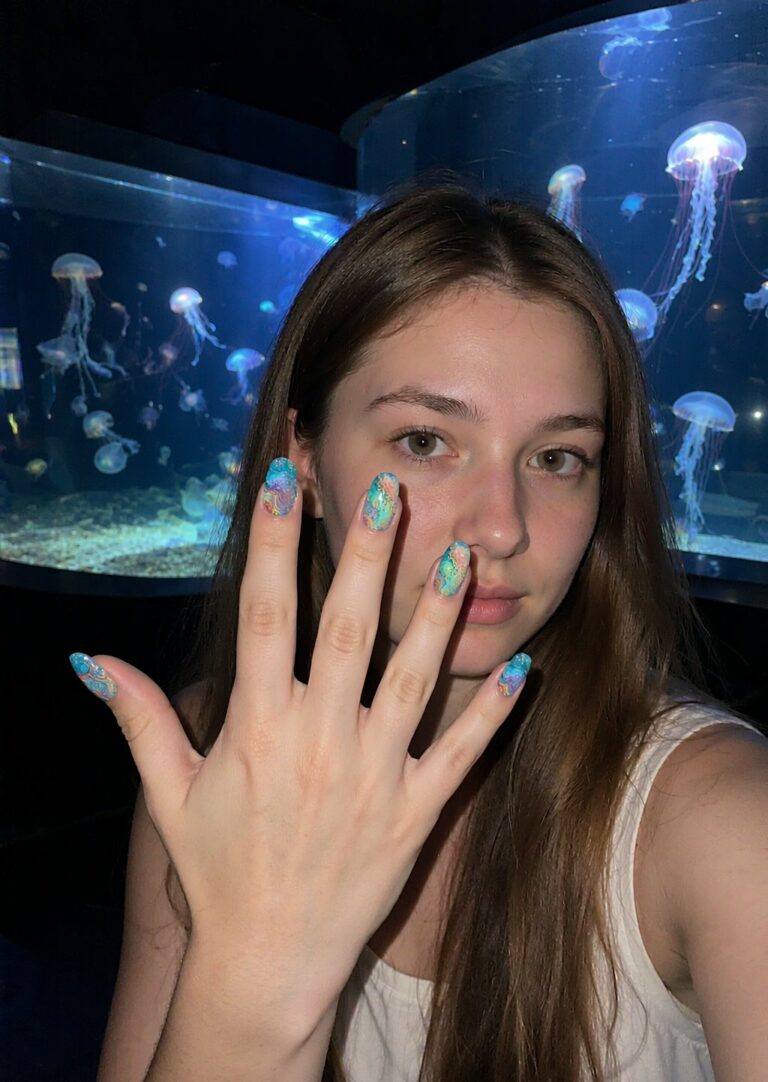
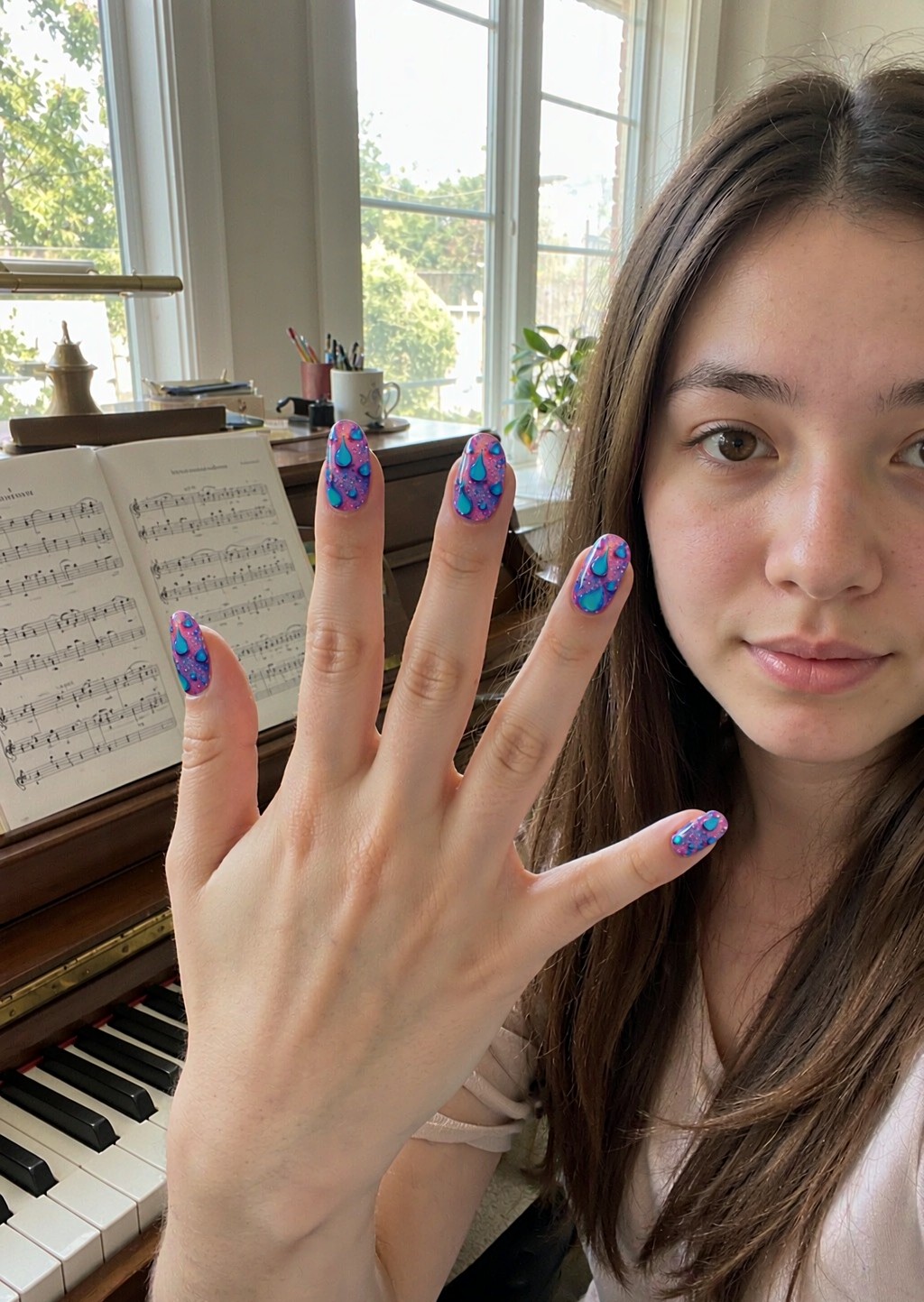
This month’s set is called Raindrop Rhythm, and it might be the most on-brand thing I’ve ever worn to work: crystal-clear teal raindrops scattered over a violet-pink iridescent background, with printed droplet art that looks genuinely dewy and dimensional once cured. One of my teens declared them “3D??” with her whole chest — but the surface stays completely smooth, so they survive hand sanitizer, constant key contact, and being pointed at measure twelve by a distracted nine-year-old.
And because I know you’re thinking it — skeptical-me ran the durability claim as an experiment. You’ve seen the angry reviews elsewhere: “NO WAY DO THESE NAILS STAY ON 14 DAYS.” Fair. That’s why I photographed my hands on day one, day seven, and day fourteen. All three photos: no lifting, no chips, full gloss, raindrops intact. The medical-grade adhesive plus the tempered gel layer genuinely carries a full three weeks of playing and teaching. The strips retire when the growth gap shows, not when they fail.
If your job puts your hands in front of an audience — piano,strings, teaching, therapy sessions, interpreting, clay, keyboards of the typing kind — your manicure is equipment, not decoration. It needs to be hard, smooth, snag-free, and low-maintenance. A box of these runs about $5.99, does a full set with strips left over, and takes one TV episode’s worth of effort per application.
The removal is gentle too: warm cuticle oil around the edges, ten patient minutes, and they lift at a low angle without any drama. Your natural nails stay intact, which matters when your natural nails are, technically, your work tools.
Your students are going to watch your hands either way — that’s the job. If you’d like those hands to carry a little weather with them, the Raindrop Rhythm strips from tonight’s encore are a box away, with hundreds of calmer designs on the same shelf if neon isn’t your studio’s tempo. Order tonight; cure before tomorrow’s first lesson.