Before you go —
we send free sample boxes to businesses evaluating our strips.
No minimum. No obligation. Just try them on real nails.
There are fifty articles telling you the nail wrap category grows somewhere between six and nine per cent a year. Almost none of them show you the profit and loss account. That is the only document that decides whether you make money.
So here is the arithmetic, using this year’s published fee schedules and a factory cost of $0.99 a box. Every figure below is a line item you can replace with your own number.
Buyers get into trouble by negotiating the factory price first. Work backwards from the shelf instead.
| Step | Real numbers seen in 2026 |
|---|---|
| Wholesale, Alibaba | $1.01 to $2.60 per unit, minimums from 10 to 300. One listing shows 366,000 units sold |
| Landed in your warehouse | Roughly $1.43 to $1.58 per box |
| Marketplace shelf | $8.99 to $14.72 |
| Brand direct, list | $17.99, discounted to $9.99 in promo |
| Premium kit tier | $35 to $50 |
Two conclusions. The finished good multiplies somewhere between ten and eighteen times on its way to the customer. And almost none of that multiple is manufacturing.
Here is the landed cost of one box in detail, on a 3,000 box order at $0.99.
| Line | Amount per box |
|---|---|
| Factory price | $0.99 |
| Duty on Chapter 33 from China, at 37.5 per cent | $0.37 |
| Sea freight, roughly 80 kg for the order | $0.07 |
| Customs broker and entry, $150 spread over 3,000 units | $0.05 |
| Labelling and prep per unit | $0.10 |
| Landed | $1.58 |
At the lower published duty estimate of 22 per cent the same box lands at $1.43. Either way, your dollar box is a dollar-and-a-half box before you sell anything. If you priced your listing off the factory quote, your margin is already wrong and you will find out at the end of the quarter.
| Channel | What it charges | The catch |
|---|---|---|
| Etsy | $0.20 listing, 6.5 per cent transaction, 3 per cent plus $0.25 processing | Around 10.8 per cent effective. Offsite Ads adds 15 per cent, drops to 12 per cent above $10,000 trailing sales, and becomes mandatory at that point |
| Amazon FBA | 8 per cent on the first $10 of price, 15 per cent above it | Plus fulfilment. $3.22 for a small standard up to 6 oz, or $2.77 if the item is under $10. Returns processing $2.12. Since January 2026 Amazon no longer preps inventory, and non-compliant inbound shipments attract defect fees of $0.32 to $5.72 per unit |
| TikTok Shop | 6 per cent in the US, 9 per cent in the UK and EU, processing included | New sellers pay 3 per cent in the US for 30 days, 1.8 per cent in the UK for 90 days, 4 per cent in the EU for 60 days. Affiliate commission of 10 to 20 per cent stacks on top, so a creator-driven order really costs 16 to 26 per cent |
| Your own store | Around 2.9 per cent plus $0.30 in payment processing | You pay for the traffic instead |
Read that table twice, because it decides your first order. The cheapest platform fee is not the cheapest channel. TikTok’s 6 per cent looks like half of Etsy’s, until a creator takes 15 per cent of the same sale.
| Line | Amount |
|---|---|
| Revenue, buyer pays shipping | $24.00 |
| Listing fee | -$0.20 |
| Transaction fee, 6.5 per cent | -$1.56 |
| Payment processing, 3 per cent plus $0.25 | -$0.97 |
| Product, two boxes | -$1.98 |
| Shipping, tracked | -$4.00 |
| Packaging | -$0.60 |
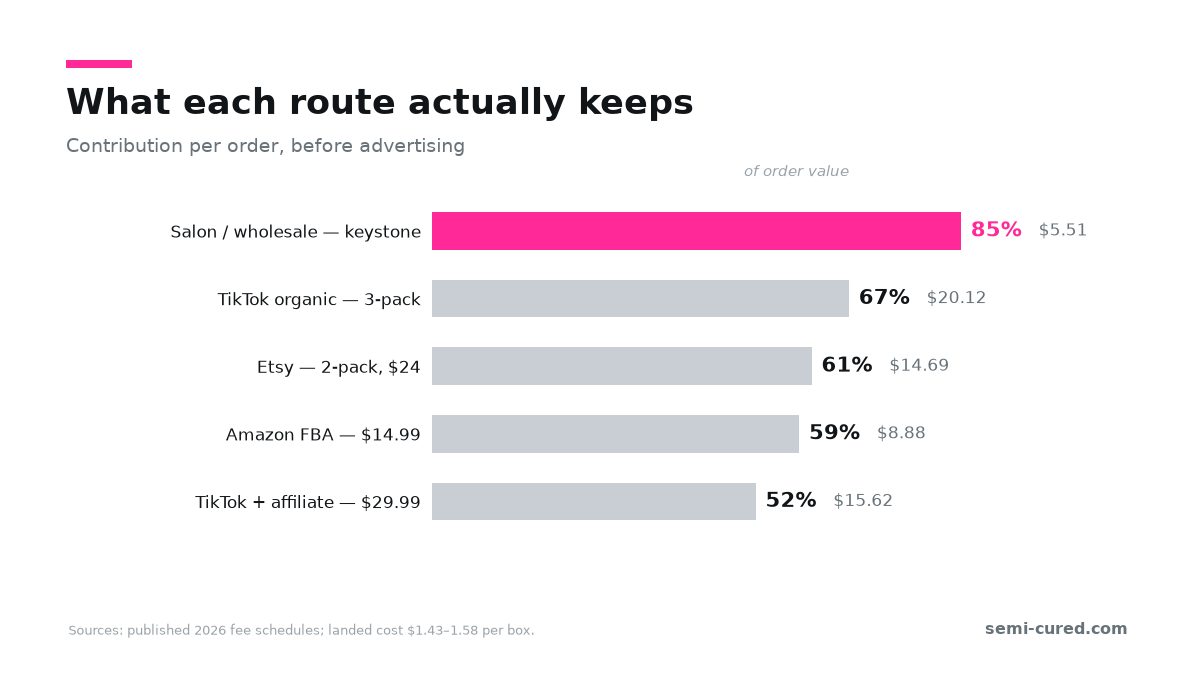
| Contribution | $14.69 |
That is 61 per cent. Now the same order arrived through an Offsite Ad, which costs another 15 per cent: contribution falls to $11.09, or 46 per cent. Cross $10,000 in trailing sales and you can no longer switch Offsite Ads off.
The lesson is not that Etsy is bad. It is that a $24 order survives Etsy fees comfortably, and a $9 order does not.
| Line | Amount |
|---|---|
| Revenue | $29.99 |
| Platform referral, 6 per cent | -$1.80 |
| Affiliate commission, 15 per cent | -$4.50 |
| Product, three boxes | -$2.97 |
| Shipping | -$4.20 |
| Packaging | -$0.90 |
| Contribution | $15.62 |
52 per cent on a creator-driven sale, and 67 per cent if the order came in organically with no affiliate. On the new-seller rate of 3 per cent you keep another $0.90 per order during the launch window.
Two costs that never appear in the fee table: refunds carry an administration fee of 20 per cent of the referral fee, capped at $5, and impulse-driven platforms return more than search-driven ones. Build a return allowance in rather than being surprised by it.
| Line | Amount |
|---|---|
| Revenue | $14.99 |
| Referral fee, 8 per cent on the first $10 | -$0.80 |
| Referral fee, 15 per cent above $10 | -$0.75 |
| FBA fulfilment, small standard | -$3.22 |
| Product | -$0.99 |
| Packaging and FNSKU labelling | -$0.35 |
| Contribution before advertising | $8.88 |
That is 59 per cent before ads, and about 47 per cent after a typical 12 per cent advertising cost. The tiered referral structure is worth understanding: price at $9.99 and the referral drops to $0.80 while the item also qualifies for low-price FBA at $2.77, leaving $5.08 of contribution on a $9.99 unit — cheaper to fulfil than the $14.99 version, if that price still works for your positioning.
Fulfilment by Amazon is the only route here where the platform handles the customer, the returns and the delivery promise. It is also the only one where a labelling error becomes a per-unit fine.
Here is the route almost nobody takes, and its economics look nothing like the others.
| Line | Amount |
|---|---|
| Your retail price | $13.00 |
| Wholesale at keystone, half of retail | $6.50 |
| Product | -$0.99 |
| Gross per set | $5.51 |
85 per cent gross margin, no ad spend, no consumer shipping, no returns processing, and a customer who reorders on a cycle instead of on a mood. Twenty salons taking 24 sets each is 480 sets, about $3,120 of revenue on under $500 of goods.
What you pay for it: 30 to 60 day payment terms, and you have to make the sale yourself. That is a phone call, a sample and a counter display, not a campaign.
And the timing is unusually good. Salons took only 8.02 per cent of nail strip distribution in 2025 against 57.8 per cent for e-commerce, while the US nail technician vacancy rate hit 14.2 per cent. A salon with unfilled chairs is not shopping for designs. It is shopping for minutes, and a strip-based service saves minutes.
Heavy users get through 6 to 12 sets a year. Sell to that cadence instead of to a one-off purchase.
| Line | Amount |
|---|---|
| Subscription price | $24.00 |
| Product, two boxes | -$1.98 |
| Packaging | -$0.60 |
| Shipping | -$4.20 |
| Total cost | $6.78 |
28 per cent of the subscription price, comfortably inside the 45 to 50 per cent ceiling that beauty subscriptions need to stay solvent. Typical subscription churn is 8 to 12 per cent a month, so the plan only works if the contents cost stays low and you offer a pause rather than forcing a cancel — a pause option reduces churn by 20 to 30 per cent. Target a lifetime value at least three times your acquisition cost.
Do not go monthly. The product does not support monthly, and an honest cadence churns less than an aggressive one.
Compliance. If you sell into the EU or UK you need a safety assessment, a product information file, a responsible person in the market, and a notification. Published 2026 prices: a combined safety report and file from around £195 to £250 per formula, a formula variation around £40, notification around £99 per product, and a responsible person from roughly £195 one-off per market then about £20 a month. Packaging EPR registration starts around £185 per country per year. Budget €300 to €800 per product per market. The timeline is the part people miss: normally two and a half to four months, and it only compresses to three or four weeks if you already hold stability and microbiological reports from a GLP or ISO 17025 lab. Ask your supplier for those before you order, not after.
Barcodes. GS1 US charges $30 for a single GTIN with no renewal, or $250 plus $50 a year for a prefix covering ten products. GS1 UK charges from £50 a year depending on turnover, with ten GTINs included. Do not buy reseller codes: the GS1 registry will show a different owner, and marketplaces check.
Duty. The $800 de minimis exemption is closed and every parcel now clears as a dutiable import. For Chapter 33 goods from China the published estimates split: one supply-chain source models beauty and personal care at 18 to 22 per cent all-in, while duty calculators pricing manicure and pedicure preparations under HTS 3304.99.50.00 show 37.5 per cent. Assume the higher number until a broker confirms your own ten-digit code, because a wrong classification can swing the rate by more than ten points. Add the merchandise processing fee at 0.3464 per cent, minimum $33.58 per entry, and a broker fee of $25 to $150. A February 2026 New York Fed study found importers and consumers absorbed 86 to 94 per cent of the tariff burden. That is a formal way of saying the duty is your cost, not the factory’s.
Returns. Amazon charges $2.12 to process a return, and you also lose the goods and gain a public review. In a category whose loudest complaint is fit, the cheapest insurance is a size chart in millimetres on the listing and a prep instruction on the pack.
Packaging that survives the post. A dented box reads as used. The $0.20 you saved on the carton is the return you will process.
Days 1 to 3. Order samples: three designs, in at least two size options. Ask for the size chart in millimetres, the MSDS, and any GLP or ISO 17025 stability and microbiology reports. Those three documents save you weeks later.
Days 4 to 10. Test on ten people with different nail widths and log where the strip lifts. If more than two of the ten report gaps at the sidewall, the supplier’s size system is the problem, not the user’s application.
Days 11 to 14. Pick one route. One channel for the first order. If you cannot fund advertising, that route is the salon, not the marketplace.
Days 15 to 20. Build the listing. Barcodes, ingredient text in the market’s language, prep instructions, a size chart image. Set the price from landed cost, with the duty line included.
Days 25 to 30. Place the first order small. Six designs in one size system, $600 to $900 of goods, not $6,000. Your first order is market research; the second order is business.
They price on the factory quote. Landed cost runs 40 to 60 per cent above it before a single sale.
They print before they test. Colour on a screen is not colour on a strip, and the pink that is too warm is an entire batch.
They buy fifty designs because the unit price was ten per cent lower. Dead stock does not cost a percentage of its price. It costs all of it.
They choose a channel with an acquisition cost they cannot fund. Etsy and Amazon rent you traffic at a price, every month, forever.
They sell into the EU without the file. The first retailer who asks for the safety report and the responsible person’s address on the label ends the conversation.
Run the arithmetic above with your own numbers before you commit. Then ask us for samples, the size chart in millimetres, and the lab reports in the same request. A supplier who can answer those three questions quickly is worth more than one who quotes ten cents less.